-
30-01-2026
Gradient hardening technology breakthrough
Jinan Haoyang Casting and Forging has successfully industrialized the "gradient hardening" technology, which has increased the lifespan of forged steel balls by 40%, reduced the breakage rate to less than 0.1%, and the wear of Φ60mm products per ton of raw materials is only 0.8kg. It saves 18% of electricity. This product has passed the EU REACH certification and has reached a cooperation agreement with LafargeHolcim. In the first quarter of 2025, the export volume will increase by 30%. The company plans to build a photovoltaic workshop and achieve full-process carbon neutrality production in 2026, continuously leading the high-end wear-resistant material market.
-
15-07-2025
"Resistant to Impact and Abrasion, Forge Steel Balls/Cast Balls Stand Out!"
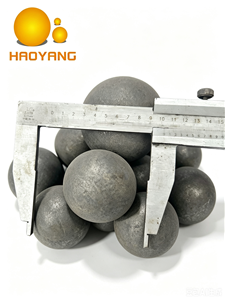
Forged steel balls and cast balls are two of the core media in the industrial grinding field, and their processes and performance differ significantly. Forged steel balls are made of low-carbon alloys, high-manganese steel, or rare earth chromium-molybdenum alloys, and are formed through heating and forging. They have the characteristics of smooth surfaces, strong impact resistance, and high toughness, with a breakage rate of less than 1%. They have excellent wear resistance and are particularly suitable for wet grinding environments in mines and power plants. Their prices are economical and are widely adopted by international giants such as Rio Tinto and BHP Billiton. Cast balls are made from low-chromium, medium-chromium, or high-chromium cast iron and are formed by pouring. Although high-chromium cast balls have high hardness (HRC 60+) and excellent wear resistance, their toughness is poor. Balls with a diameter over 3 meters are prone to cracking in ball mills, and their costs are higher. They are mostly used in dry ball mills in the cement industry. The core difference between the two lies in: The forging process optimizes the metal flow structure, and the anti-cracking performance of forged steel balls is 5-10 times that of cast balls. However, cast balls rely on increasing chromium content to enhance wear resistance, but at the expense of corrosion resistance. When selecting, it is necessary to consider the working conditions (dry/wet grinding, equipment scale), cost, and performance requirements. For example, large mines prefer forged steel balls, while cement plants tend to use high-chromium cast balls.