Leading the upgrading of the steel ball forging industry with the "gradient forging" technology
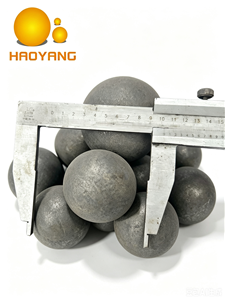
In the high-end equipment manufacturing park of Zhangqiu District, on the intelligent production line of Jinan Haoyang Forging Co., Ltd., the red steel billets, after going through 12 forging processes, transform into smooth-surfaced and uniformly hard wear-resistant steel balls. This enterprise, which has been deeply engaged in forging for over a decade, is leveraging its independently developed "gradient forging" technology to promote "Jinan-made" steel balls to the global high-end market.
"Traditional forged steel balls either lack sufficient hardness, which affects their lifespan, or have insufficient toughness, making them prone to cracking. We developed a segmented temperature-controlled gradient forging process by simulating the temperature field changes during the forging process. The company's technical director, Engineer Li, explained that this technology enables the steel balls to form a gradient structure with a hard surface like porcelain and a flexible core like tendons. After being tested by a third party, the product's impact toughness is ≥ 12J/cm², and the breakage rate is lower than 0.5%. Both indicators exceed the international standards."
Thanks to technological breakthroughs, the company's export performance has significantly improved in recent years. In 2024, Haoyang Forging's forged steel balls obtained the EU CE certification and successfully entered the European markets such as Germany and Poland. The largest single order reached 800 tons. "European customers have strict requirements for product precision. Our steel ball size tolerance can be controlled within ±0.5mm, and the logistics timeliness is stable at 28 days. This enables us to stand out in the bidding process." The order data presented by the foreign trade department manager, Mr. Zhang, shows that currently, the company's export volume accounts for 45% of the total, and the customer repeat purchase rate exceeds 70%.
In terms of intelligent transformation, the company invested 20 million yuan to build a digital workshop, introducing industrial robots for automatic loading and unloading. The MES system monitors production data in real time, increasing the product qualification rate from 92% to 99.2%. "Previously, quality inspection relied on manual sampling. Now each steel ball has a 'digital ID', and the entire process data from raw materials to finished products can be traced." Ms. Wang, from the quality inspection department who used to work in the government office, said that the meticulous management has earned the company more trust from high-end customers.
Looking to the future, Haoyang Forging & Casting plans to expand its production capacity to 50,000 tons per year, focusing on developing super-large forged steel balls (with diameters ranging from 150 to 180 mm) for large-scale mines. It will also collaborate with the Materials College of Shandong University to research and develop new alloy materials, aiming to enter the top ten global suppliers of forged steel balls within three years.